Home workout programming: adapt to client equipment
You can program an effective home workout by adapting three things: the exercise selection to whatever equipment the client has, the progression levers (reps, tempo, difficulty rather than just load), and the volume. The principles that make training work do not change at home, only the tools do. This article covers how to program for different levels of equipment, how to keep progressing without heavy weights, how to convert a gym program to a home one, and how calisthenics can give bodyweight training real structure.
Can a client really progress at home?
Yes, within limits. The engine of progress, progressive overload, still applies at home; you just drive it with different levers than loading a barbell. As long as the training gets gradually harder over time, a client can build real strength and muscle with little or no equipment. What changes is the ceiling and the method: a near-advanced lifter chasing a heavy squat will eventually need a bar, but most clients have plenty of room to progress at home for a long time.
Assess the client's available equipment
Before you program anything, take an inventory. Home setups fall into a few rough categories, and each one changes what you can prescribe.
- No equipment: bodyweight only
- Minimal: resistance bands, a pair of dumbbells, or a kettlebell
- A home gym: a barbell, rack, and weights
Ask exactly what the client has, including space and whether they have a pull-up bar, before you build anything. A program written for equipment the client does not own is a program they cannot follow.
Build the program around the equipment
The logic is the same as in a gym: cover the main movement patterns, push, pull, squat, hinge, carry, and choose the best exercise each setup allows for each one.
No equipment
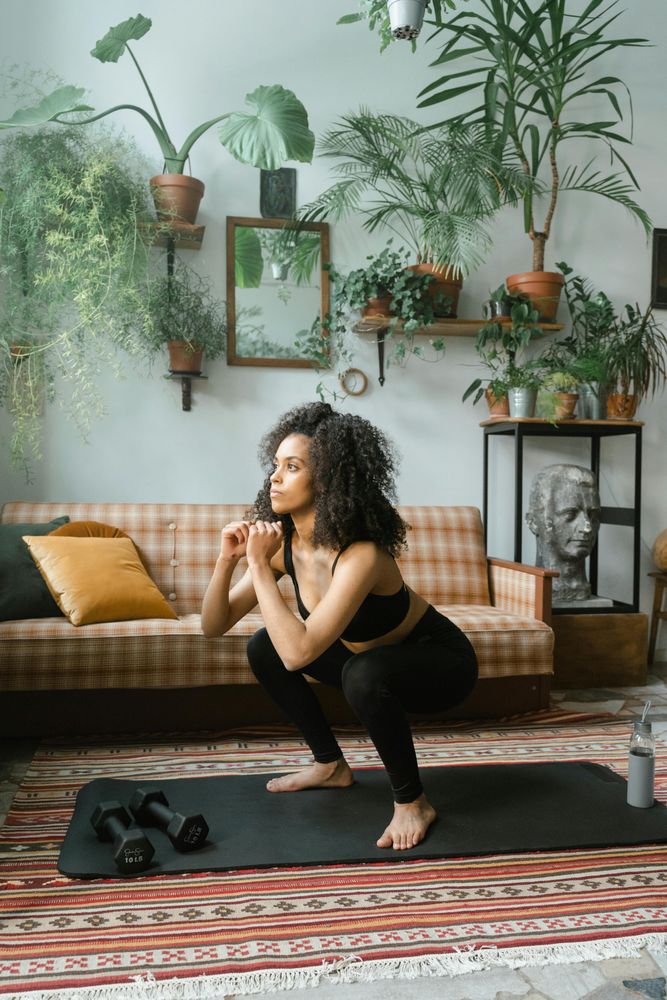
With bodyweight only, build around progressions of the basics: push-up variations for pushing, rows under a table or with anything you can hang from for pulling, squats and lunges for the legs, hip hinges and glute work. The challenge is loading the legs, where bodyweight runs out fastest, which is where single-leg variations earn their place.
Minimal equipment
Bands and a pair of dumbbells expand the options enormously. Bands add resistance to presses, rows, and pull-aparts; dumbbells or a kettlebell let you load squats, lunges, presses, and hinges properly. With this much, most clients can train every pattern with enough resistance to progress for a long time.
A home gym
With a barbell, rack, and weights, you can essentially program as you would in a commercial gym. At this point the equipment is no longer the limiting factor, the same principles apply as anywhere.
| Equipment level | What you can program |
|---|---|
| No equipment | Bodyweight progressions, all patterns, limited leg loading |
| Bands or dumbbells | Every pattern with real resistance |
| Home gym | Full programming, as in a commercial gym |
Progress without heavy loads
When you cannot just add weight, you progress with other levers. These are the tools that make bodyweight and light-equipment training keep working.
- More reps or sets: the simplest progression
- Slower tempo: more time under tension from the same movement
- Single-limb variations: one leg or one arm doubles the relative load
- Greater range of motion: deficit push-ups, deeper squats
- Harder exercise variations: from knee push-ups to standard to decline to single-arm
- More density: same work in less time, or shorter rest
The key idea is the same as progressive overload anywhere: make it gradually harder. At home you just have more levers than load to choose from.
Adapt an existing gym program to home
You do not always start from scratch. Often you are converting a gym program for a client now training at home. Keep the structure and the intent, the patterns, the volume, the progression, and swap each exercise for the best home equivalent.
| Gym exercise | Home substitution |
|---|---|
| Barbell bench press | Push-up variations, banded press |
| Lat pulldown | Pull-ups, band pulldowns, table rows |
| Barbell squat | Goblet squat, split squat, pistol progression |
| Romanian deadlift | Single-leg hinge, band or dumbbell RDL |
| Overhead press | Dumbbell or band press, pike push-up |
A reusable substitution table like this saves you rebuilding it for every client who moves to home training.
Going further: structuring bodyweight with calisthenics
When a client trains mainly with bodyweight, calisthenics gives that work a real framework to progress within, rather than just doing random push-ups. It comes in three broad styles. Set and rep calisthenics works strength and muscle through sets and reps on the basics, pull-ups, push-ups, dips, squats, much like weight training without the weights. Freestyle is more dynamic and acrobatic, built on bar movements and explosive skills. Static focuses on isometric strength holds, the planche, the front lever, and similar feats. For a client committed to bodyweight training, these styles offer clear progressions and goals, and the discipline is worth exploring in its own right.
Common mistakes to avoid
A few errors undermine home programming.
Copying a gym program unchanged, so it calls for equipment the client does not have. Neglecting progression, treating home training as just "do some exercises" with no plan to make it harder. Underestimating bodyweight, assuming nothing serious can be built without heavy loads. And miscalibrating volume, either far too little to stimulate anything or so much it becomes endless circuits with no real progression.
Build a reusable substitution table
A lack of equipment is a programming problem, and programming can solve it. The same principles that drive results in a gym, the right patterns, real progression, sensible volume, work just as well at home once you adapt the tools to what the client has.
The practical step is to build yourself a reusable substitution table, gym exercise to home equivalent, that you can pull from whenever a client trains at home. Pair it with the progression levers above, and you can write effective home programs as quickly and confidently as gym ones.